

Why Your Marble Floor Has Lost Its Shine (and How We Get It Back)
You remember the day those marble floors were first polished. They were like a mirror. You could see the reflection of the chandelier, the sunlight streaming through the windows, and maybe even your own satisfied grin. It looked expensive. It felt grand.
But look at it now.
That mirror finish has been replaced by a dull, cloudy haze. There are patches that look “foggy,” little white rings from a forgotten glass of wine, and perhaps a few scratches that seem to catch every bit of dust in the room. It’s frustrating. You have probably tried every cleaning product on the market, from the “miracle” sprays at the supermarket to some organic concoction you found online.
But the shine isn’t coming back. Not with a mop and bucket, anyway.
I’ve spent over 20 years looking at floors just like yours. At Master Marble, we’ve seen it all: from grand hotel lobbies in Central London to family kitchens that have seen better days. The truth is, marble is a bit of a diva. It’s beautiful, but it’s temperamental.
If your floor has lost its soul, don’t panic. You don’t need to rip it out. You just need to understand why it happened and how we bring that “wow factor” back.
The “Sandpaper” Effect: Why Traffic Kills the Glow
Here is the thing about marble: it’s actually quite soft. On the Mohs scale of mineral hardness, marble usually sits around a 3 or 4. Compare that to a diamond (which is a 10) or even granite, and you’ll realize that marble is relatively easy to scratch.
Every time someone walks across your floor, they are carrying microscopic particles of grit, sand, and dirt on the soles of their shoes. As they walk, that grit acts exactly like fine-grade sandpaper.
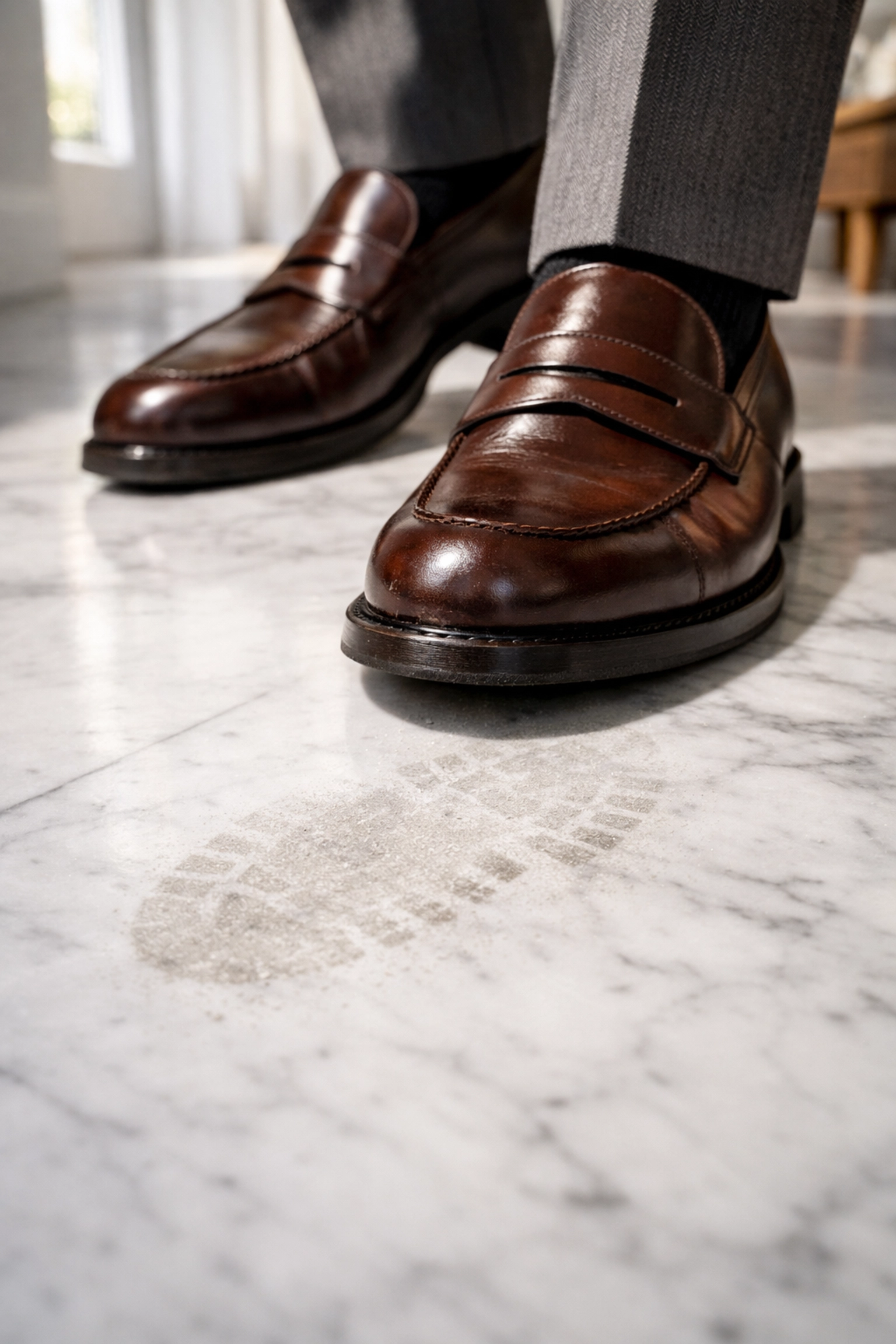
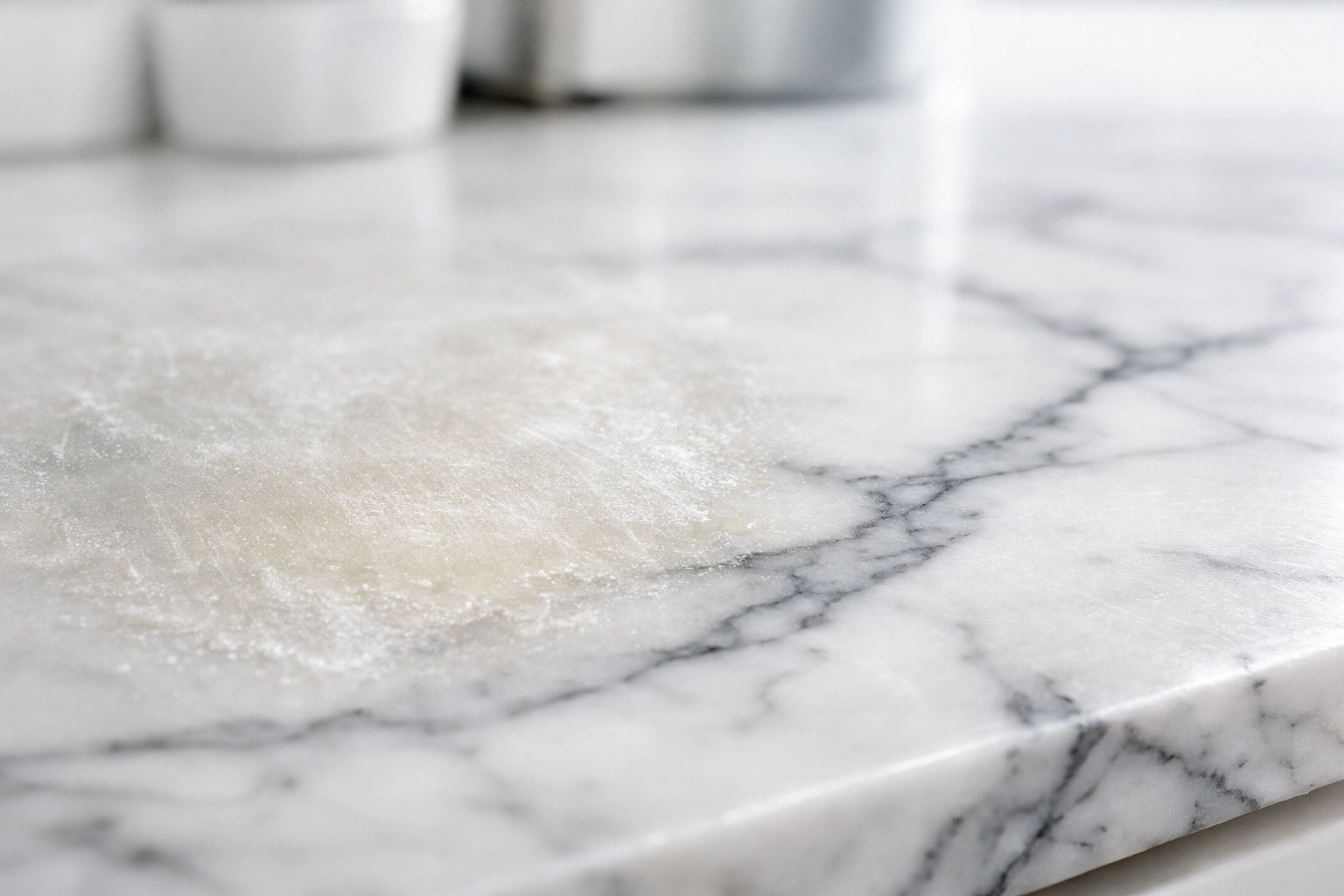
Slowly, over months and years, those thousands of tiny footsteps grind away the polished surface. You won’t notice it happening day by day. But eventually, the surface becomes covered in millions of micro-scratches. These scratches scatter light instead of reflecting it. That is why the floor looks dull. It isn’t “dirty” in the traditional sense; the surface is simply too rough to bounce light back to your eyes.
We see this most often in “traffic lanes”: that path from the front door to the kitchen or around the dining table. If the edges of your room are still shiny but the middle is dull, you’re looking at mechanical wear and tear.
The “Natural Cleaner” Trap
I’ve seen this a thousand times, and frankly, it’s a bit of a tragedy. A homeowner wants to be eco-friendly or save a few quid, so they use vinegar or lemon juice to clean their marble.
Stop right there. That is absolute rubbish advice.
Marble is primarily made of calcium carbonate. Do you know what happens when you put acid on calcium carbonate? It reacts. It fizzes. The acid literally dissolves a tiny amount of the stone on contact. This creates what we call an “etch mark.”
It looks like a dull, pale spot. People often mistake these for stains and try to scrub them off. But you can’t scrub an etch mark away because it’s not on the stone: it’s a physical change to the stone. Using acidic cleaners on the whole floor is essentially giving your marble a chemical peel it didn’t ask for.
If you’ve been using the wrong products, check out our guide on marble floor cleaning in London to see what you should be using instead.
The Problem with “Supermarket” Waxes
Another common mistake is trying to “re-shine” the floor using topical waxes or “shining” liquids from the local hardware shop.
These products are a temporary fix at best and a nightmare at worst. They sit on top of the stone, trapping dirt underneath. Eventually, the wax itself gets scratched and starts to yellow. Then you’re left with a floor that looks plastic, smeared, and even more dull than before.
Professional marble restoration isn’t about adding a layer of gunk on top. It’s about Refining the stone itself.
How We Get the Shine Back: The Master Marble Method
So, how do we actually fix it? We don’t use magic potions or secret waxes. We use physics.
1. Deep Cleaning and Stripping
First, we have to get rid of all that old wax and built-up grime. We use professional-grade, pH-neutral cleaners and rotary machines to get deep into the pores of the stone. If some “cowboy” has been there before us and layered on cheap sealants, we strip those back until we’re working with the raw stone.
2. Diamond Polishing (The Real Secret)
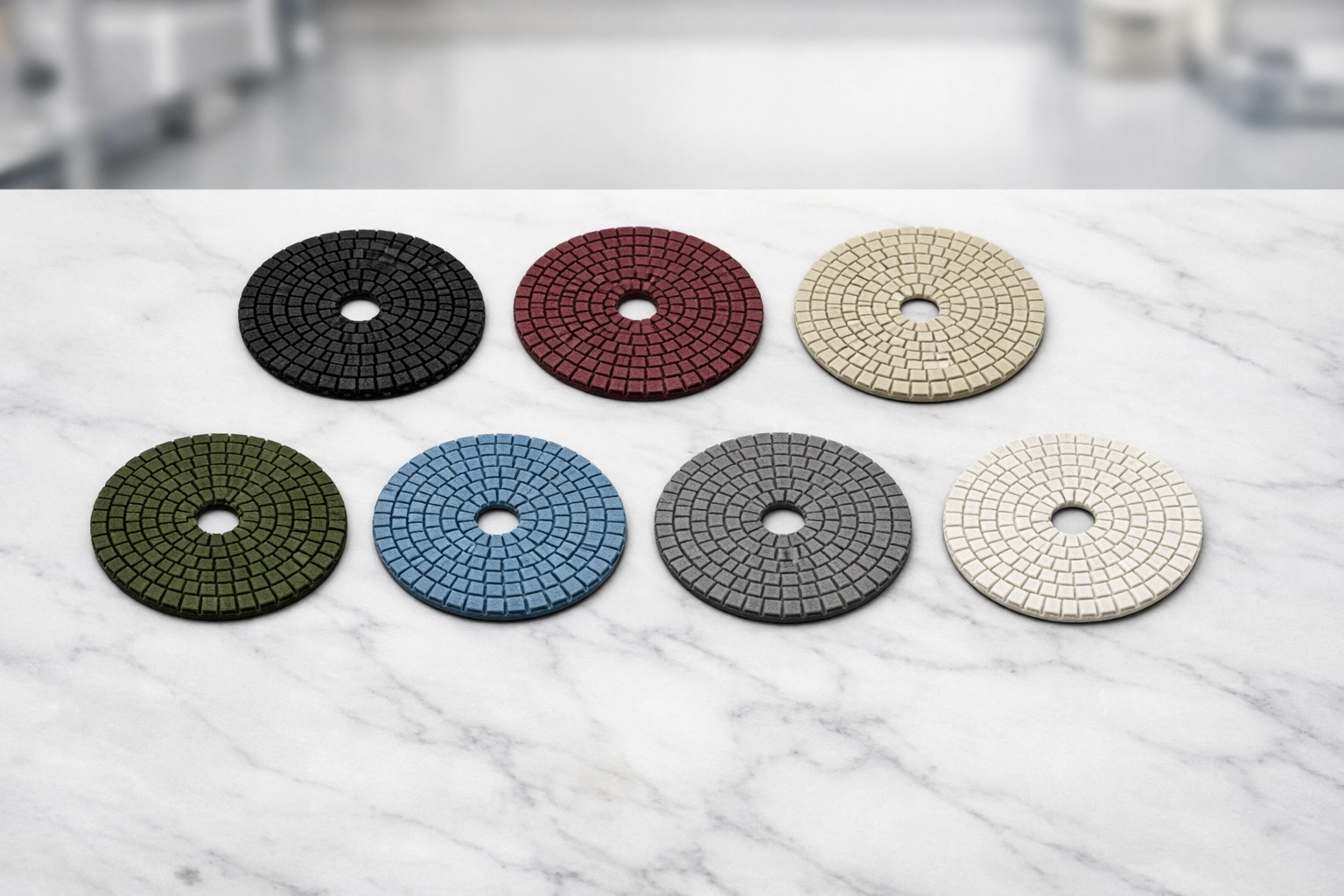
This is where the magic happens. To get a mirror finish, we have to “resurface” the stone. We use heavy-duty floor machines equipped with diamond-impregnated pads.
We start with a coarse grit: maybe a 50 or 100 grit: to grind away the scratches, etch marks, and surface damage. Then, we move through a sequence of increasingly finer grits (200, 400, 800, 1500, all the way up to 3000+).
Think of it like polishing a gemstone. By the time we hit the high grits, the stone is so smooth that it naturally begins to reflect light again. This isn’t a “fake” shine; it’s the natural beauty of the marble being revealed. This is what we mean by marble polishing.
3. Honing vs. High Gloss
Not everyone wants a mirror finish. Sometimes, a “honed” finish: which is more of a satin, matte look: suits the property better. The process is the same, we just stop at a lower grit. It’s entirely up to you and the aesthetic of your home.
4. Sealing and Protection
Once the floor is beautiful again, we have to protect it. We apply high-quality, impregnating sealers. These don’t sit on top of the stone; they soak into the pores to provide a barrier against oils and water-based stains. It won’t make the floor “bulletproof” against acid (nothing will), but it gives you that vital window of time to wipe up a spill before it causes damage.
For more on how to keep it looking this way, our marble maintenance guide is a must-read.
Why Restoration is Smarter Than Replacement
I often get asked if it’s just easier to rip the floor up and start again. My answer is always the same: Why would you?
- Cost: Restoration is a fraction of the cost of buying new stone, paying for specialized labor to rip out the old one, and then paying for a tiler to lay the new floor. We’re talking thousands of pounds in savings.
- Hassle: Ripping out a floor is a dusty, noisy, miserable process that can take weeks. Professional marble cleaning and restoration usually takes a few days, and we use “wet” systems that mean there’s virtually no dust in your home.
- Character: Older marble often has a character and quality you can’t easily find in modern batches. Why lose that history?
If you want to see the difference for yourself, take a look at some of our recent stone restoration projects in London. The results speak louder than I ever could.
Can You Do It Yourself?
I’ll be honest with you. You can buy “marble polishing kits” online. If you have a tiny dull spot on a bathroom vanity, they might do a decent job. But for a whole floor? Don’t bother.
Without the right weight of machinery and the experience to know exactly when to switch grits, you’ll likely end up with “picture framing” (where the edges look different from the middle) or wavy, uneven patches. It’s a craft that takes years to master. We’ve been doing this for over two decades: there’s no substitute for that kind of “seen-it-all” expertise.
Ready to See Your Floor Shine Again?
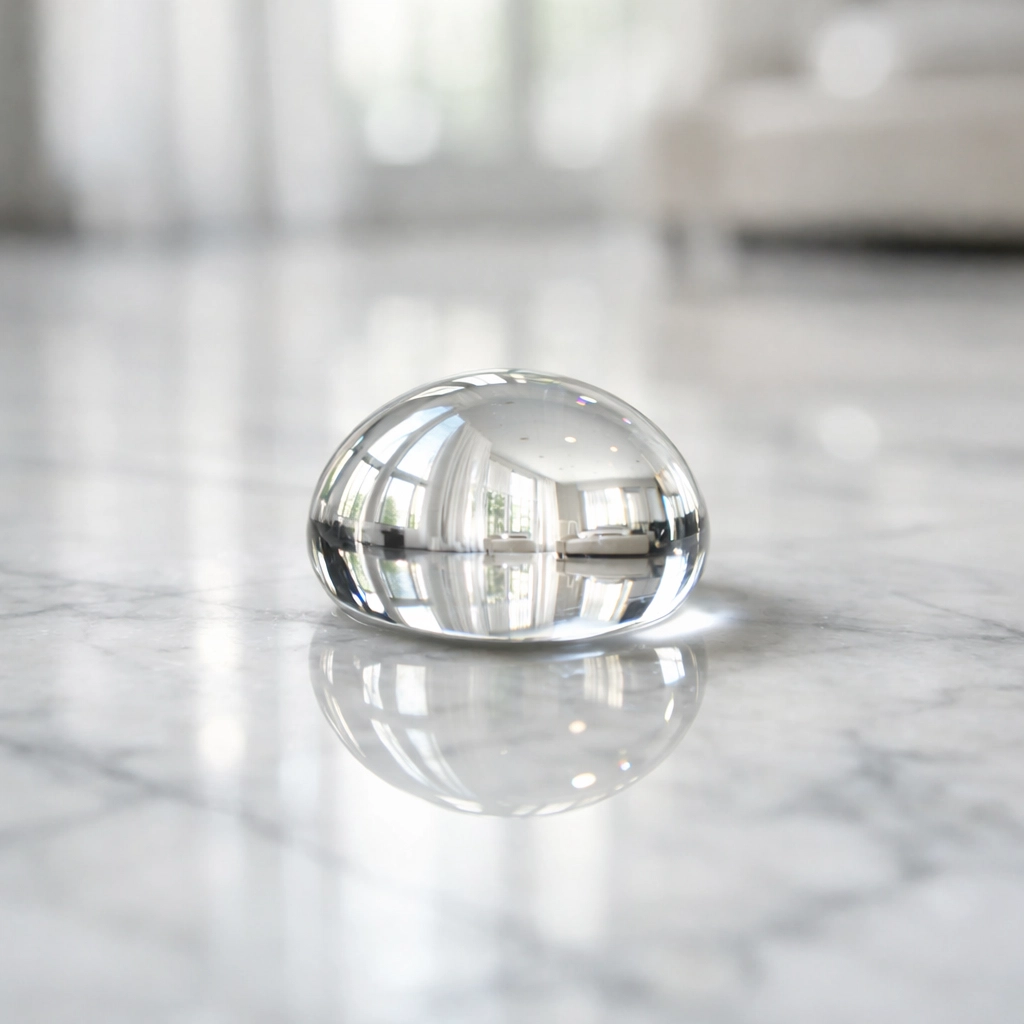
A dull marble floor is a weight on a room. It makes everything feel slightly neglected, no matter how clean the rest of the house is. But it doesn’t have to stay that way.
Whether you’ve got a classic Carrara hallway or a bespoke Terrazzo floor that has lost its luster, we can help. We don’t just “clean” floors; we restore them to their former glory.
Don’t just take my word for it: read our customer testimonials to see what your neighbors in London think of our work.
Ready to get that mirror finish back? Contact us today for a no-nonsense quote. Let’s stop talking about how dull your floor is and start making it the centerpiece of your home again.